
Before ever considering which fall prevention system to install, the first question to ask should always be ‘Can working at height be avoided?’ Is there another solution, one which would remove the risk of a fall entirely? This solution can often be incorporated into the design of a building. To look at possible solutions, we should first consider the reason for accessing a roof. The main reason is usually maintenance related, with work to be carried out on equipment such as air conditioning units etc. One such solution would be to store this equipment elsewhere if possible, such as a plant room, where accessing the roof isn’t necessary.
Working at Height Considerations - Fall Restraint v Fall Arrest
First Consideration: Collective Protection
If working at height cannot be avoided, then collective protection such as a guardrail system should be the next consideration. This would provide greater protection than a fall prevention or fall arrest system, where a fall is still a higher possibility. Along with this, other factors would then need to be considered, such as a rescue plan and the appropriate provision and maintenance of PPE.

Rooftop Guardrail System
Sometimes it is not always practical to install a guardrail system on a roof. Fall restraint is then always the preferred option over fall arrest, as this lessens the risk and doesn’t include the need for a rescue plan. Fall restraint will allow the worker to get to the roofs edge, but not fall over. Fall arrest on the other hand, will allow the worker to fall over the edge, where a rescue plan then needs to be in place to retrieve the victim as soon as possible.
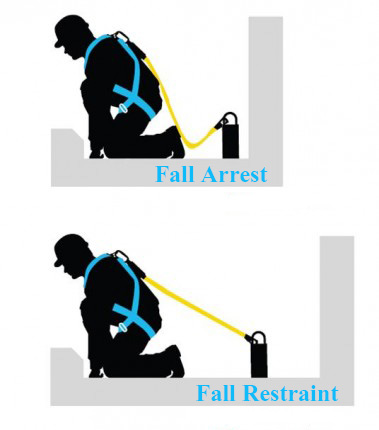
Fall Arrest v Fall Restraint
This is governed by the surrounding conditions. It is not always possible to achieve a fall restraint system, an example being where a narrow ledge needs to be accessed and the workers lanyard would be too long for restraint to work.
Likewise, a fall arrest system is not always possible either, as sometimes the working area is not high enough from the ground to allow for a safe fall without impact. Alternatively, the working area could be too high from the ground, and a suitable rescue plan could not be implemented for this reason.
Cable Systems
Cable systems require regular inspection and maintenance to ensure that equipment has not been tampered with or damaged in any way. All users of PFPE should be properly trained in how to use their equipment. This includes not only knowing how to correctly apply their harnesses and connect up to the cable via their lanyard, but also what to look for in terms of defects. This can include tears, abrasions, damage to webbing and stitching, paint contamination and damaged karabiners. To limit the chance of damage to PPE, care should be taken to ensure that all elements are stored away carefully and out of harm’s way.
Wearing a Harness
Your harness should be self-inspected before every use. The steps to this include:
- Hold the harness up and scan it to check for any obvious abnormalities. This can include checking to make sure that each side of the harness corresponds with the opposite side and that there is no part of it missing
- While passing arms through the harness, check that the webbing is not twisted in any way
- Ensure that the ‘D’ ring is correctly positioned and that the harness is sitting correctly across the shoulders
- Pull or release the slack ends of the shoulder straps to ensure that the sub-pelvic strap is positioned firmly under the buttocks

Before any work at height is carried out, an assessment should be carried out:
This should include…
- Looking for any potential risks/hazards
- Evaluating who may be harmed by these risks, and how it might happen
- Evaluating the risks and whether or not more action needs to be taken
No matter how familiar one is with a roof surface, the same care and consideration needs to be taken each time that area is accessed. Creating a fool proof procedure which contains the same measures and adhering to this system is the best way to ensure your safety. Over familiarity with a working area can lead to carelessness and put the individual in harms way.
This is precisely why taking the same safety precautions each and every time is vital.
If you have any questions about working at height, you can submit your query on the form below.